
Defying Subjectivity: An Alternate Educational System
- Apr 13, 2017
- 3 min read
In my previous blog post, I discussed how subjectivity is an issue plaguing our society. While most associate subjectivity with qualitative grading on creativity projects (especially in writing and the arts), subjectivity is heavily embedded in the very nature of standardized tests. The specific questions that are chosen to be asked on these exams can make all the difference between a student's success and failure.

So how does the world combat subjectivity? As I alluded to in my last post, eliminating bias is physically impossible for a human being. Nevertheless, we as a society do have the power to limit bias and subjectivity.
This entire blog is on the problems with competition between high school students. Could fostering cooperation, rather than encouraging creativity and taking own paths, be a possible way to limit subjectivity in education?
It turns out that two summers ago, I witnessed what a possible alternative education system was like, and what it merits entailed.
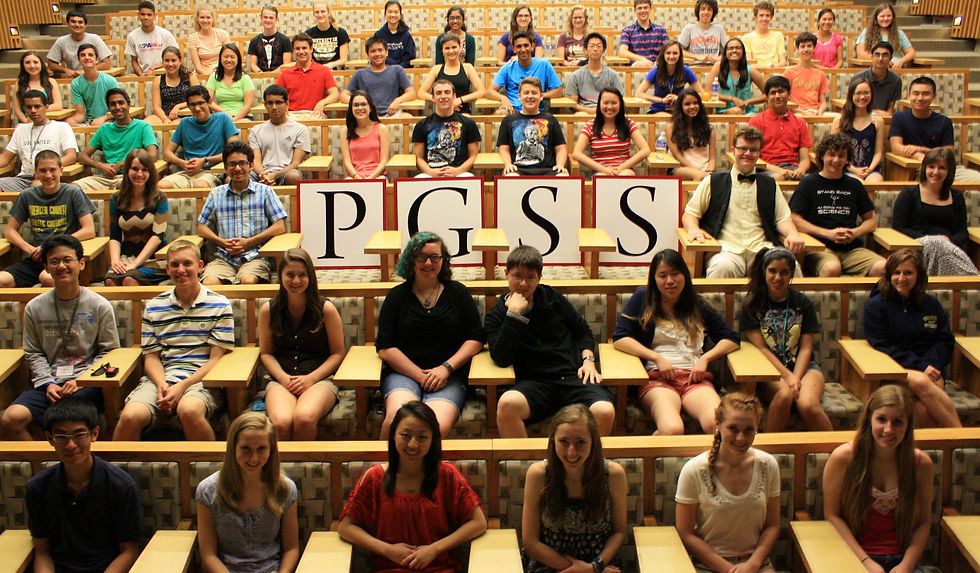
I attended the Pennsylvania Governor's School for the Sciences (PGSS), a five-week science-geared summer program held at Carnegie Mellon University. Initially I was expecting a "report card" from PGSS that would transfer to colleges. However, it turned out that their entire academic curriculum, on physics, discrete math, algorithm design, organic chemistry, and genomics, was based on completion.
Now when I say completion, I don't mean turning in that sloppily-done, entirely wrong calculus homework assignment. The problems were graded by the professors, and we as students were forced to perform re-dos until the entire assignment was 100% correct.
Immediately, the issue of copying another one's work would arise from such a system of purely assignments, called "problem sets" at PGSS. Predictably, for a group of sixty gifted high schoolers, the problem sets were extremely challenging, especially for one to complete on his or her own. The program very specifically stated that these problems are impossible to complete by oneself, regardless of the technology and resources available here at CMU.
Importantly, collaboration was perhaps the strongest focus of PGSS, beyond enriching students with an introduction to college-level science courses. For many of the students, who often came from competitive high schools, PGSS offered them their first view on how the real world works: as teams of people rather than discrete individuals.
So what are the implications of adding such a collaborative problem-set approach to high schools?
As in any educational system that could ever be devised, there are benefits and drawbacks. A purely problem-set based curriculum would completely eliminate any competition from high schools, except those who are capable and those who are not. A problem-set approach is also easily scalable to different levels, ranging from College Preparatory to Advanced Placement. Such assignments can be made to challenge a group of students at that level, and even more readily allow these students to find their comfort levels.
In terms of vocational education, or training for the job, a problem-set curriculum will often be more effective than today's exam and paper system. Jobs in commercial services and manufacturing would most likely benefit from problem-sets, as the work performed by these workers is very procedural in nature without too much need for creativity. Finance and actuarial jobs, too, despite being high-skilled and high-paying, are nonetheless sequential in practice; much of the work they perform is rather repetitive and requires knowledge about what needs to be done.
Ironically, however, the fields promoted by PGSS (science, engineering, and research), would be hurt by a problem-set educational system. There is no doubt that, for better or worse, such a curriculum would stratify high school students into distinct "classes" of academic capability, but creativity goes beyond capability. Beyond the obvious fact that creativity and potential to innovate are hurt by incorporating problem-sets, stratification limits the ability for creative enterprises to hand-pick candidates that would be the best fit.
Effectively, there is no perfect solution to solving the competition crisis engulfing the world's high schools. A mix of creative projects and standardized examinations has without a doubt improved society's livelihood by leaps and bounds. But is such a system placing too much stress on high school students, where every little difference between one and another matters? A problem-set system will undoubtedly relieve such stress in our students, but would also limit the desire for innovation and improvement.
To conclude my final post on this blog, I give you this: Our world is at a pivotal point. Should we continually fight for innovation and improving our society, or be content with what we have and focus our times on other matters?
(I don't want to get into politics with this, but the above question is a serious issue defining the entire issue of competition)
Sources:
http://sciences.pa-gov-schools.org/program_overview
https://www.agb.org/trusteeship/2014/1/liberal-education-vs-professional-education-false-choice


Comments